

- Home
- Investors Centre
- Sustainability
- Talent
- News
- Insights
- TH!NK
- Corporate Governance
- Who we are
- Board of Directors
- Community
- MCB Offices
Contact Info
Mauritius as a Strategic Shipping Node: Capitalising on Gulf Challenges and Cape - Rerouting

Global Disruptions and the Shift Towards Cape Rerouting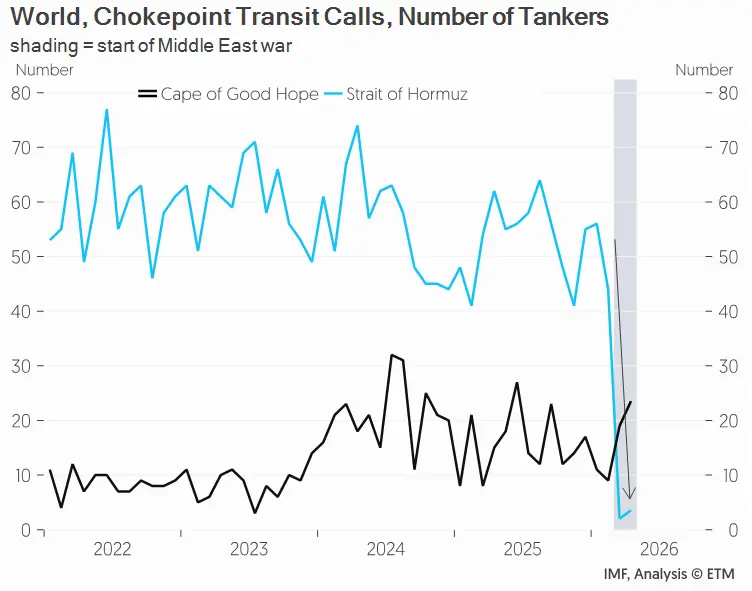
Geopolitical tensions in the Gulf region, encompassing Houthi activity in the Red Sea and Iran’s effective closure of the Strait of Hormuz, have compelled major shipping lines to reroute via the Cape of Good Hope. This shift has extended voyage durations by approximately two weeks on key Asia-Europe and Asia-North America trades, increasing fuel consumption and driving demand for reliable intermediate stops. Such disruptions have created fresh opportunities for countries positioned along the alternative southern African route, including Mauritius, Namibia and South Africa.
Vessel traffic around the Cape of Good Hope has risen markedly, with diversions increasing by 112% as of early March 2026 amid renewed instability in the Middle East. Namibia’s Port of Walvis Bay has benefited notably from this dynamic, recording rising demand for ship-to-ship bunkering and transhipment services. As it is, the port has attracted new bunkering operations, including from suppliers such as Flex Commodities, and was designated by MSC as a transhipment hub for the Southern Africa West Coast in early 2025. Infrastructure upgrades, including the deepening of the entrance channel to 16.5 metres in 2025, have enabled larger vessels to call, supporting increased activity linked to Cape rerouting. Trade data for February 2026 further underscores Walvis Bay’s role as Namibia’s principal gateway, handling significant export and import volumes amid the broader rerouting trend.
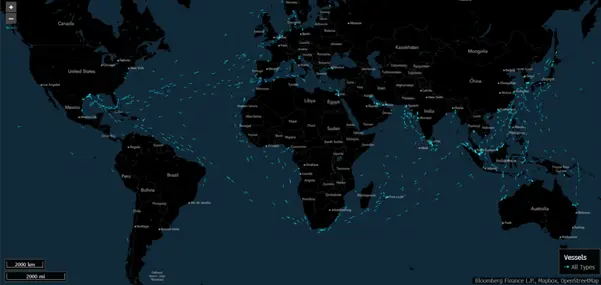
In South Africa, the Port of Cape Town has experienced a comparable surge in diverted vessels. This has driven heightened inquiries for bunkering, crew changes, and ancillary services. However, structural constraints such as congestion, limited dedicated infrastructure, and regulatory factors have so far restricted actual bunker volume growth, with official statements indicating no significant increase in ship-to-ship bunkering uptake as of late March 2026. Other South African ports, including Durban, have seen modest increases in vessel traffic, yet competition from more agile regional hubs has often limited realised benefits.
Port Louis as a Strategic Indian Ocean Node
Against this backdrop, Port Louis is emerging as a more prominent player along the east–west Indian Ocean corridor, reflecting its strategic location amid shifting global shipping patterns. Its geographic position, political stability, and service diversity allow it to function as a bunkering hub, technical stop, dry bulk gateway, and feeder connection point. Unlike ports focused on a single segment, Port Louis offers multi‑segment facilities, enabling it to capture value across wet freight, dry bulk, and containerised transhipment, albeit with capacity and operational limits.
Surge in Wet Freight and Bunkering Activity
Wet freight activity at Port Louis centres on bunkering and petroleum product handling, which has experienced pronounced growth amid sustained Cape diversions. Bunker fuel sales nearly doubled to approximately one million tonnes in 2025, reflecting heightened vessel traffic. In March 2026, bunker calls rose 42% to 294 vessels from 207 the prior month, with fuel volumes loaded increasing to over 109,000 tonnes.
The port offers ship-to-ship refuelling at anchorage, enabling rapid turnaround without berthing delays and providing a clear advantage over more congested South African facilities. Multiple international suppliers provide grades, including marine gas oil (GO 2500), fuel oil (FO 180 and FO 380), supported by government incentives such as exemptions from excise duty, value-added tax, and corporate tax. Dedicated oil jetties with depths up to 14.5 metres accommodate product tankers and chemical carriers. As a result, Port Louis has become a preferred technical and refuelling stop for deep-sea vessels, including those operated by lines such as Maersk, MSC, and CMA CGM.
Dry Freight Operations and Consistent Routes
Dry bulk activity remains more locally oriented yet benefits from the broader rerouting environment. Port Louis features dedicated facilities, including the Bulk Sugar Terminal and multiple quays equipped for grab and pneumatic discharge, with depths of approximately 12.2 metres at relevant berths. Handysize to Capesize bulk carriers regularly call for the following commodities:
- Grain imports: wheat, maize, and soya bean meal
- Coal and fertilisers: inbound for local cement production and agriculture
- Sugar: traditional exports supplemented by imported raw sugar from origins such as Thailand and Brazil for refining
- Other dry bulk: clinker and miscellaneous commodities
These operations integrate with east-west trades linking Asia to Southern and East Africa, as well as Europe, positioning Mauritius as an intermediate or feeder point.
Supporting Container and Feeder Connectivity
Regular liner and feeder services enhance connectivity for both dry and wet segments. Consistent routes include the Cape Town Express (direct link to Cape Town, South Africa), connections to Salalah (Oman) and Réunion, and broader East/Southern African feeder networks serving ports such as Durban and Mombasa. These services facilitate efficient distribution of containerised dry cargo while indirectly supporting bulk and tanker calls through multimodal integration.
Economic Impact and Infrastructure Investments
The strategic advantages have translated into measurable gains for Mauritius’s export profile. The share of “ship’s stores and bunkers” in total exports has risen significantly over the years, increasing from around 15% before the COVID-19 period to approximately 30% recently. During the Red Sea crisis linked to Houthi attacks, port calls increased and export proceeds in this category rose by some 45% in 2024.
In the 2025/26 National Budget, the Mauritian Government announced an investment of approximately Rs 5.4 billion by the Mauritius Ports Authority. This funding will support the expansion of the cruise jetty, the construction of a small jetty for bunker barges, the acquisition of additional tugs, and the expansion of the Mauritius Container Terminal, thereby strengthening capacity and operational efficiency. These initiatives are complemented by a Memorandum of Understanding between the Government of Mauritius and the Government of India on the modalities for the implementation of projects financed under the Special Economic Package, including the provision of port equipment through the Cargo Handling Corporation Ltd.
Bottlenecks Limiting Full Value Capture
Despite these gains, Mauritius is not yet fully capitalising on the opportunity created by sustained global disruptions. A major source of concern remains port productivity, particularly lengthy ship turnaround times . In the 2024 Container Port Performance Index produced by the World Bank and S&P Global Market Intelligence, Port Louis was ranked 369th out of over 400 ports globally, underscoring significant inefficiencies in port operations and management.
Additional constraints include limited anchorage space, insufficient fuel storage capacity, tight inventories, and relatively high bunkering prices. These factors have led many major shipping lines to also consider bunkering elsewhere and use Port Louis primarily for fuel top‑ups. Operational inefficiencies such as restricted operating hours, staffing limitations, clearance delays, rising land lease rates, and lengthy approval and environmental assessment processes further elevate costs and discourage large‑scale investment in storage and infrastructure.
Infrastructure and Outlook
Ongoing modernisation at Port Louis, encompassing digitisation, potential green bunkering initiatives for alternative fuels, and capacity expansions, aims to sustain momentum. The port’s tax incentives, reliable anchorage, and one-stop-shop approach continue to attract tankers, bulk carriers, and other vessels for bunkering, cargo operations, crew changes, and stores.
This modernisation drive is anchored in the Port Master Plan, approved by the Board of the Mauritius Ports Authority, which provides a structured roadmap for addressing operational weaknesses and future capacity needs up to 2050. The Plan identifies seven major infrastructure projects, with an estimated total investment of Rs 56.3 billion, focused on expanding container handling capacity, upgrading core infrastructure, and improving port efficiency and productivity.
Conclusion
In summary, persistent geopolitical disruptions in the Gulf have structurally elevated Mauritius’s role within increasingly diversified global supply chains. Port Louis already delivers tangible value as a reliable bunkering and technical hub for wet freight on Cape‑rerouted deep‑sea trades, while continuing to sustain stable dry bulk activity linked to regional imports and sugar logistics. As shipping lines navigate ongoing Middle East volatility alongside longer‑term fuel supply and decarbonisation considerations, ports along the southern African and Indian Ocean corridor—including Mauritius, Walvis Bay, and Cape Town—stand to gain further by improving capacity, productivity, and service reliability.
For Mauritius, the opportunity is both immediate and strategic. Addressing port productivity gaps, expanding capacity, and delivering the infrastructure pipeline outlined in the Port Master Plan will be critical to transitioning Port Louis from a beneficiary of disruption to a consistently competitive regional hub.
For more information, please contact MCB Global Markets Team on gmsales@mcb.mu
Published in collaboration with our Strategy, Research and Development team and our Financial Markets research partner, ETM Group.
Disclaimer
“This publication is provided for general information purposes only and should not be construed as investment advice, a recommendation, an offer or solicitation to buy or sell any financial instrument or to participate in any trading strategy. The views and opinions expressed are those of the author(s) as of the date indicated and are subject to change without notice.
They do not necessarily represent the views of The Mauritius Commercial Bank Ltd (“MCB”) or any of its affiliates. Although the information contained herein is obtained from sources believed to be reliable, MCB makes no representation or warranty, express or implied, as to its accuracy, completeness, or fitness for any particular purpose. Past performance is not indicative of future results, and all investments involve risk, including the possible loss of principal.
Neither MCB nor any of its directors, officers, or employees accepts any liability for any direct or consequential loss arising from any use of this publication or its contents. Recipients should seek independent financial, legal or tax advice before making any investment decisions.”
Recent Articles

TH!NK

.webp?sfvrsn=bdba599c_1)

Subscribe to our Email Alerts
Stay up-to-date with our latest releases delivered straight to your inbox.
Contact
Don't hesitate to contact us for additional info
Email alerts
Keep abreast of our financial updates.